什么是 geoip 处理器?
简而言之,一种将 IP 地址转换为地理位置数据的处理器。请参阅我之前的文章 “Elasticsearch:运用 geoip 处理器来丰富数据”。 举个例子,你有一个 IP 地址“8.8.8.8”,应该按如下方式解析:
1.  PUT _ingest/pipeline/geoip
2.  {
3.    "description" : "Add geoip info",
4.    "processors" : [
5.      {
6.        "geoip" : {
7.          "field" : "ip"
8.        }
9.      }
10.    ]
11.  }

13.  PUT my_index/_doc/my_id?pipeline=geoip
14.  {
15.    "ip": "8.8.8.8"
16.  }

18.  GET my_index/_doc/my_id
上面最后一个命令返回的结果是:
1.  {
2.    "_index" : "my_index",
3.    "_type" : "_doc",
4.    "_id" : "my_id",
5.    "_version" : 4,
6.    "_seq_no" : 5,
7.    "_primary_term" : 9,
8.    "found" : true,
9.    "_source" : {
10.      "geoip" : {
11.        "continent_name" : "North America",
12.        "country_iso_code" : "US",
13.        "location" : {
14.          "lon" : -97.822,
15.          "lat" : 37.751
16.        }
17.      },
18.      "ip" : "8.8.8.8"
19.    }
20.  }
当你期望用于图表绘制的经纬度对(Kibana 地图可视化)或者你只是想知道此请求的来源(例如本例中的美国)时,地理位置将很有用。
一个奇怪的例外
对于大多数情况,Elasticsearch 发行版应该有可用的支持 geolite2 数据库文件。 然而,有时你可能会发现你的发行版未能使用这些文件。 例外情况是这样的句子“_geoip_database_unavailable_GeoLite2-City.mmdb”。 显然缺少一个 geolite2 数据库文件。
要进一步证明 geolite2 文件是否可用,请运行以下命令:
![图片转存失败,建议将图片保存下来直接上传
`
1. POST _ingest/pipeline/_simulate
2. {
3. "pipeline": {
4. "processors": [
5. {
6. "geoip": {
7. "field": "location"
8. }
9. }
10. ]
11. },
12. "docs": [
13. {
14. "_source": {
15. "location": "8.8.8.8"
16. }
17. }
18. ]
19. }
` (https://csdnimg.cn/release/blogv2/dist/pc/img/newCodeMoreWhite.png)
]()```
在我的电脑上显示如下的响应:
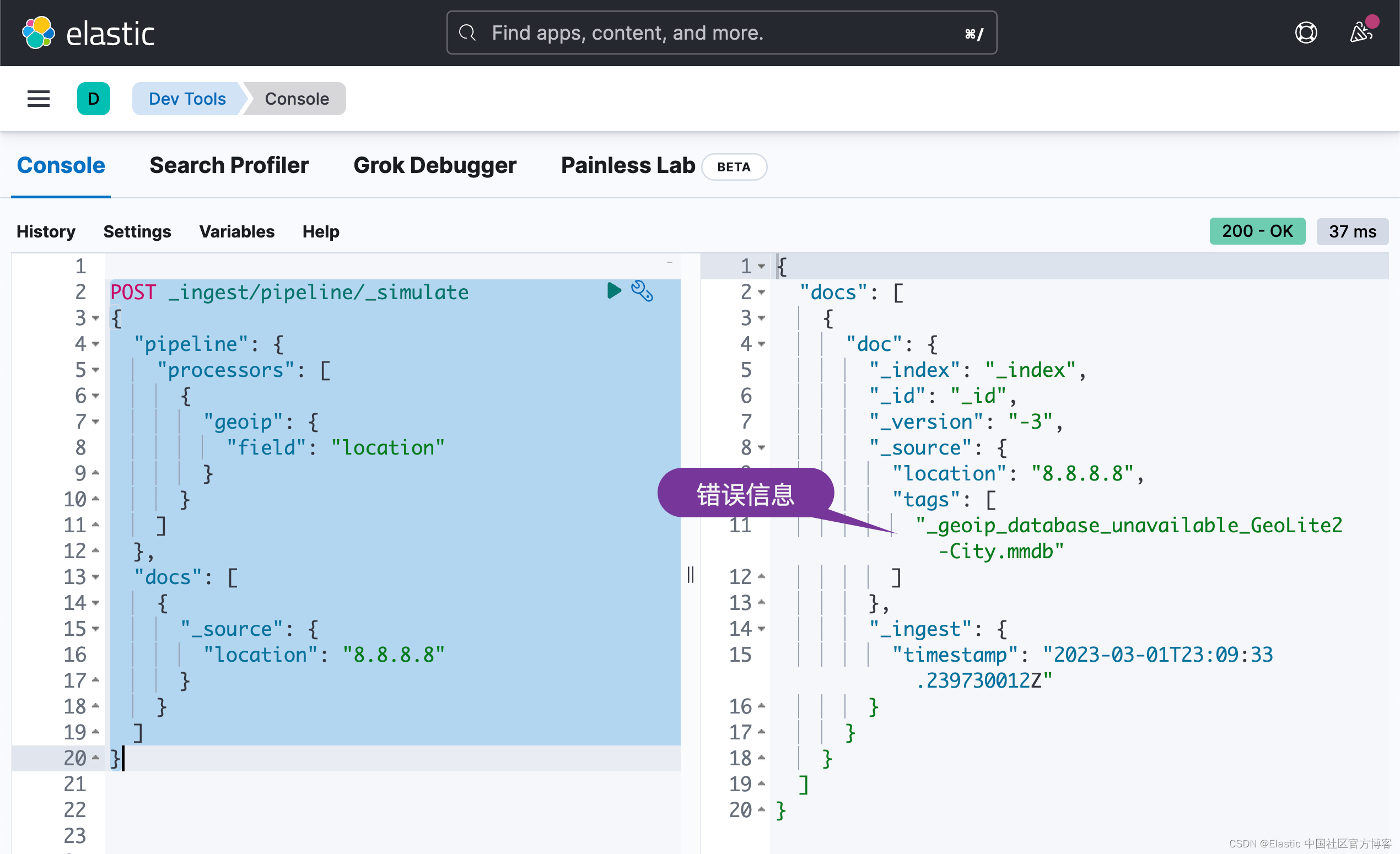
如果你遇到 “_geoip_database_unavailable_GeoLite2-City.mmdb” 异常,恭喜……你是幸运儿。 你找对地方了 [Smile]。
解决方案
====
运行以下测试并检查数据库文件是否存在:
-
check the database file availability
- GET _ingest/geoip/stats
在我的电脑上显示:
- {
- "stats": {
-
"successful_downloads": 0, -
"failed_downloads": 1, -
"total_download_time": 0, -
"databases_count": 0, -
"skipped_updates": 0, -
"expired_databases": 3 - },
- "nodes": {}
- }
如果你看到结果显示一个空节点(nodes)……那么可能由于某些原因预期的文件不可用。

接下来运行以下命令以启用 Elasticsearch 以再次下载和管理数据库文件
- PUT _cluster/settings
- {
- "persistent": {
-
"ingest": { -
"geoip": { -
"downloader": { -
"enabled": "true" -
} -
} -
} - }
- }
上述命令显示相应:
- {
- "acknowledged": true,
- "persistent": {
-
"ingest": { -
"geoip": { -
"downloader": { -
"enabled": "true" -
} -
} -
} - },
- "transient": {}
- }
等过一会儿,我执行如下的命令:
- POST _ingest/pipeline/_simulate
- {
- "pipeline": {
-
"processors": [ -
{ -
"geoip": { -
"field": "location" -
} -
} -
] - },
- "docs": [
-
{ -
"_source": { -
"location": "8.8.8.8" -
} -
} - ]
- }
上面命令显示的结果是:
- {
- "docs": [
-
{ -
"doc": { -
"_index": "_index", -
"_id": "_id", -
"_version": "-3", -
"_source": { -
"location": "8.8.8.8", -
"geoip": { -
"continent_name": "North America", -
"region_iso_code": "US-CA", -
"city_name": "Los Angeles", -
"country_iso_code": "US", -
"country_name": "United States", -
"region_name": "California", -
"location": { -
"lon": -118.2441, -
"lat": 34.0544 -
} -
} -
}, -
"_ingest": { -
"timestamp": "2023-03-01T23:22:39.676904Z" -
} -
} -
} - ]
- }
如果我们再次执行如下的命令:
GET _ingest/geoip/stats
我们会发现:
- {
- "stats": {
-
"successful_downloads": 0, -
"failed_downloads": 1, -
"total_download_time": 0, -
"databases_count": 0, -
"skipped_updates": 0, -
"expired_databases": 0 - },
- "nodes": {
-
"o75KS8A4ReKg36ILS1BK1A": { -
"databases": [ -
{ -
"name": "GeoLite2-ASN.mmdb" -
}, -
{ -
"name": "GeoLite2-Country.mmdb" -
}, -
{ -
"name": "GeoLite2-City.mmdb" -
} -
], -
"files_in_temp": [ -
"GeoLite2-ASN.mmdb_elastic-geoip-database-service-agreement-LICENSE.txt", -
"GeoLite2-ASN.mmdb_LICENSE.txt", -
"GeoLite2-City.mmdb_LICENSE.txt", -
"GeoLite2-Country.mmdb_elastic-geoip-database-service-agreement-LICENSE.txt", -
"GeoLite2-ASN.mmdb", -
"GeoLite2-City.mmdb_COPYRIGHT.txt", -
"GeoLite2-City.mmdb", -
"GeoLite2-City.mmdb_elastic-geoip-database-service-agreement-LICENSE.txt", -
"GeoLite2-Country.mmdb_LICENSE.txt", -
"GeoLite2-Country.mmdb", -
"GeoLite2-ASN.mmdb_COPYRIGHT.txt", -
"GeoLite2-Country.mmdb_COPYRIGHT.txt", -
"GeoLite2-City.mmdb_README.txt" -
] -
} - }
- }
这次,我们可以看到 nodes 里的数据是有数据的。