

Rethinking CSS
Go Atomic for Scaling, Performance and Simplicity
A slide deck by John Polacek
...or just scroll
↓
Open-Mindedness Required
The following content flies in the face of traditional CSS
If you love the way you write CSS
and don’t want to change...
then don’t.
( Obligatory disclaimer )
What is Atomic CSS?
Why use Atomic CSS?
Why is this so controversial?
Where is Atomic CSS in use?
How do I get started with Atomic CSS?
What is Atomic CSS?
( also known as Functional CSS )
You probably already write
Helper / Utility Classes
.clearfix .grid-* .hidden
Why Do Helper Classes Help?
Easy to understand + Easy to add/remove
How many times do you
declare the same properties?
margin
padding
width
color
font-size
font-weight
...etc.
font-style
text-align
border
4... 9... 42... 167... ?
It could be
1
Utility Classes All* The Things!
* Most of

Atomic CSS is the approach to CSS architecture that favors small, single-purpose classes with names based on visual function.
Source: Let’s Define Exactly What Atomic CSS is (CSS Tricks)What does it look like?
!!! Hot Drama Alert !!!
The following code may provoke strong reactions in some people.
You have been warned.
For example, to do this...
Sign In
Join
Signing up for an account is quick and easy.
You might do this...
<div class="box-640 flex pad-3 bgr-white shadow rounded">
  <div class="col-6 s-col-12 pad-3-right s-pad-1-right s-border-bottom s-pad-3-bottom s-marg-3-bottom">
    <h5 class="text-light text-blue-lt pad-2-bottom">Sign In</h5>
    <form id="loginForm" class="pad-1-right">
      <input class="marg-1-bottom" type="text" placeholder="User Name" required="required">
      <input class="marg-3-bottom" type="text" placeholder="Password" required="required">
      <input type="submit" class="btn float-right marg-1-top" value="Log In">
    </form>
  </div>
  <div class="col-6 s-col-12 pad-3-left border-left s-border-0 s-pad-0">
    <h5 class="text-light text-blue-lt pad-2-bottom pad-1-left s-pad-0-left">Join</h5>
    <p class="pad-3-bottom pad-1-left s-pad-0-left">Signing up for an account is quick and easy.</p>
    <div class="wide pad-3-top pad-1-left">
      <button id="createAccount" class="float-right">Create Account</button>
    </div>
  </div>
</div>
"box-640 flex pad-3 bgr-white shadow rounded".box-640 {
width:100%;
max-width: 640px;
}.flex {
display: flex;
flex-wrap: wrap;
}.shadow {
box-shadow: 0px 0px 20px 0px rgba(0,0,0,0.1);
}.bgr-white {
background-color: #fff;
}.rounded {
border-radius: 4px;
}.pad-3 {
padding: 3.2rem;
}“Functional CSS is just shifting complexity out of stylesheets and into templates.”
Vince Speelman
Front End Engineer at TED
Traditional CSS
Write HTML
Write CSS
Atomic CSS
Write HTML
Atomic CSS Class Names
Shorthand
Favors brevity
.f1 { font-size: 3rem; }
.ma0 { margin: 0; }
Longhand
Favors Readability
.fontsize-xxl { font-size: 3rem; }
.marg-0 { margin: 0; }
.margin-0 { margin: 0; }
Atomic CSS Architectures
Static
Familiar way to write CSS
Use a preprocessor
Unit-based design system
Easily understood
Enforceable style rules
Programmatic
No more writing CSS
Use a build tool
Automatic CSS generation
Fully optimized
No unused styles
Why use Atomic CSS?
As heard on the
Front End Happy Hour Podcast
“Unfortunately you have to use CSS.”
Front End Engineer at Netflix
“I’m really bad at CSS.”
Front End Engineer at Evernote
“You try to write something clean, but then it turns into something shitty.”
Front End Engineer at LinkedIn
“At LinkedIn we have a massive CSS file that is 3.5MB.”
Front End Engineer at LinkedIn
(Alternate title for this talk)
Atomic CSS
Your Life Could Be Easier
“Naming CSS Stuff Is Really Hard”
Ethan Muller
Front End Developer at Sparkbox
Naming CSS Stuff Is Really Hard
At-A-Glance Understandability
<div class="inner"> <div class="pad-2">
We Have a Weight Problem
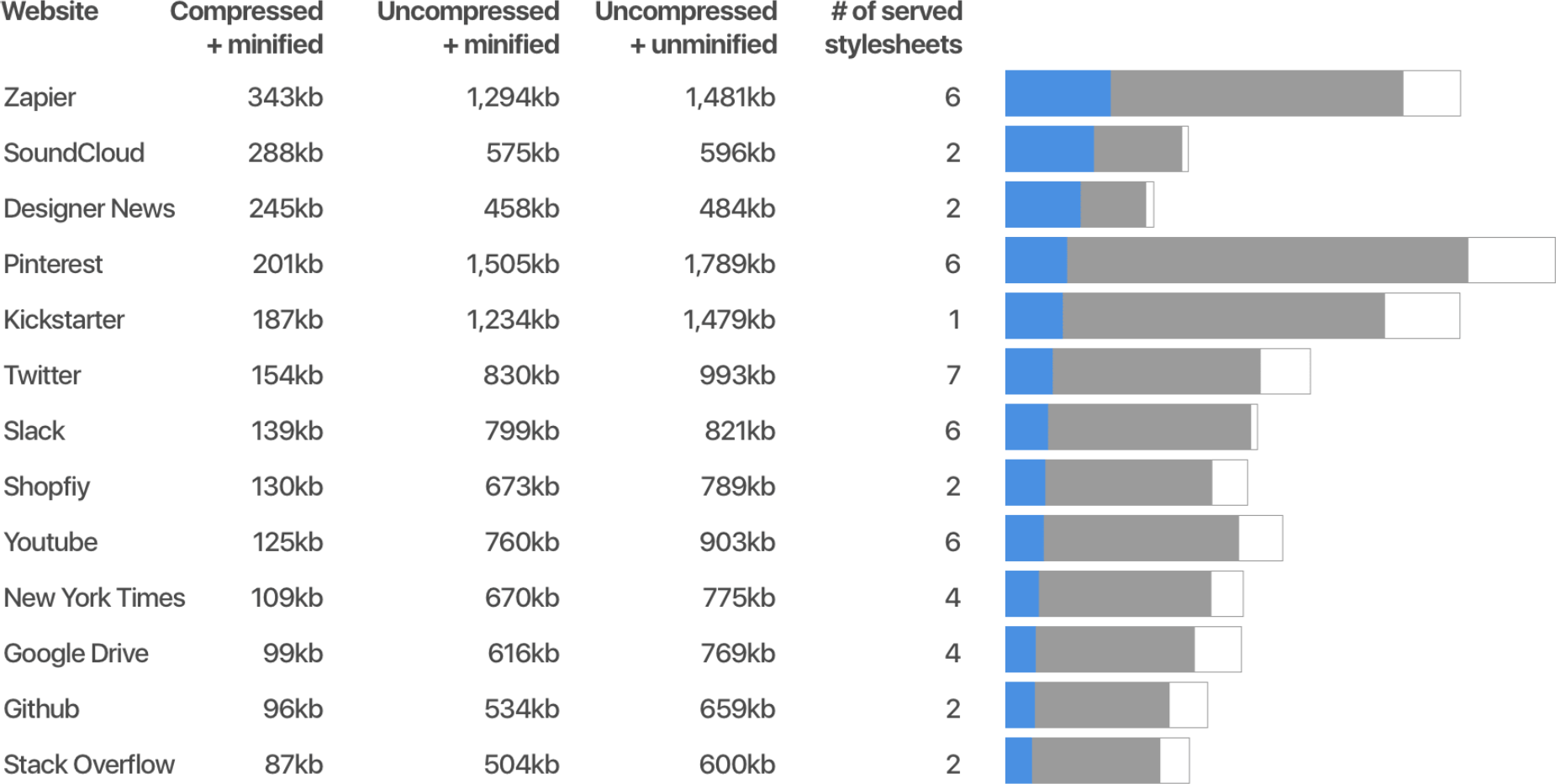
“15kb of CSS is all you’ll ever need.”
Philip Ardeljan
15kb of CSS is all you’ll ever need.
Too Much C in CSS
Every time you write a style declaration,
you create an exception to a default behavior.
Less cascade leads to flatter, simpler CSS.
Traditional CSS
The older your codebase is
More levels of cascade.
Selectors get longer.
File sizes get bigger.
More complexity.
You will never stop writing CSS.
Atomic CSS
The older your codebase is
The less CSS you will write.
Possibly none at all.
Maintainability
How do you know you have maintainable CSS?
When you no longer need to write any.
Immutability is Essential
Never Do This
.text-black { color:navy; }Instead Do This
.text-navy { color:navy; }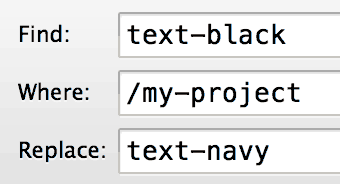
Or This
.text-primary { color:navy; }Infinite Re-Usability
Single purpose, immutable classes
lead to...
conflict-free, reliable composability.
“Simple, obvious styles are quicker to internalize,
Brent Jackson
easier to use, and more widely adopted.”
Basscss Design Principles
Design Consistency
Force limitation on variations of spacing, typography, colors, etc.
Making a styleguide is helpful!
.bgr-blue .bgr-blue-dk .bgr-green .bgr-green-dk .bgr-pink .bgr-purple .bgr-grey .bgr-red .pad-0 .pad-1 .pad-2 .pad-3 h1, .text-120 h2, .text-96 h3, .text-64 h4, .text-48 h5, .text-36 h6, .text-24 body, .text-18 small, .text-14
Experimentation
Apply and remove styles on a web page like a painter working on a canvas

Productivity Boost
“Working with functional CSS, you’re spending 99% of your time in HTML. Your productivity is incredibly high because your brain doesn’t need to context switch between markup and stylesheet.”
Simon Vrachliotis
Full re-write in 10 days with tachyons and functional CSS: A case study
“Small tweaks like margin can be adjusted with a single class change in your HTML. It allows you to fix bugs without writing any additional CSS. I can’t even tell you how amazing this feels.”
Marcelo Somers
Rationalizing Functional CSS
I think of it like this...
Writing CSS is...
Planning
to build things
Writing HTML is...
Building
the things
Portability
Set custom spacing, typography, colors
and breakpoints for each new project.
Case In Point
Zero new classes* were written in the making of this preso
CSS generated via SASS config**
* Except for that pulsing button at the top. That was pretty cool.
** Built with the Expressive CSS Starter Kit and Simple Flex Grid
Not Just About File Size
It’s about file size over time.
It’s about CSS complexity at scale
My Experience
The evolution of my company’s CSS architecture
A few days before I started
2013–07–23
# of Commits 575 Test Suite 702 Repo Size 444MB CSS Size 109.4k(41 CSS files)My first task: implement responsive web design
2013–09–03
# of Commits 925 Test Suite 743 Repo Size 465MB CSS Size 123.1k(41 CSS files)Next task: Combine 41 stylesheets into 1
2013–09–07
# of Commits 1500 Test Suite 813 Repo Size 467MB CSS Size 105.6k(1 CSS file)One year later...
2014–09–15
# of Commits 4812 Test Suite 1088 Repo Size 481MB CSS Size 151.2k(1 CSS file)Using Traditional CSS
43%growth of CSS size 3%growth of repo sizeContinued growth...
2015–05–06
# of Commits 7,726 Test Suite 1,373 Repo Size 485MB CSS Size 183.2kFirst optimization attempt
(removed unused styles, separate admin stylesheet)
2015–10–09
# of Commits 9,692 Test Suite 1,505 Repo Size 487MB CSS Size 116.8kRefactor to Functional CSS
2015–10–18
# of Commits 9,830 Test Suite 1,508 Repo Size 491MB CSS Size 81.3kInitial Results
30% reduction in CSS
Could have reduced further, but kept some legacy styles
A year and a half later...
2017–05–29
# of Commits 20,257 Test Suite 2,046 Repo Size 593MB CSS Size 72.7k10% smaller yet
(as we phase out legacy CSS)
For example...
New Feature
New View
New UI
Zero New CSS

A Year and a Half with Atomic CSS

To Open Source,
or Not to Open Source?
I abstracted the work into a library called Expressive CSS.
Then I sat on it for weeks.
Then I read this.
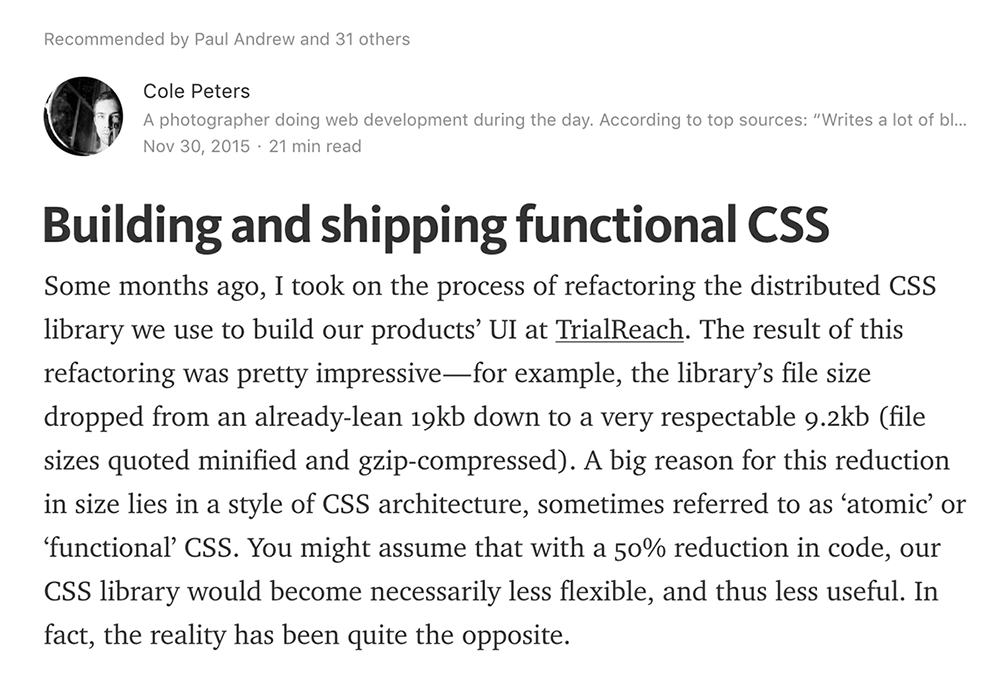
So I shipped this.

Then people said this.

Content & Display Patterns with Expressive CSS
Why is Atomic CSS controversial?
Ugly HTML?
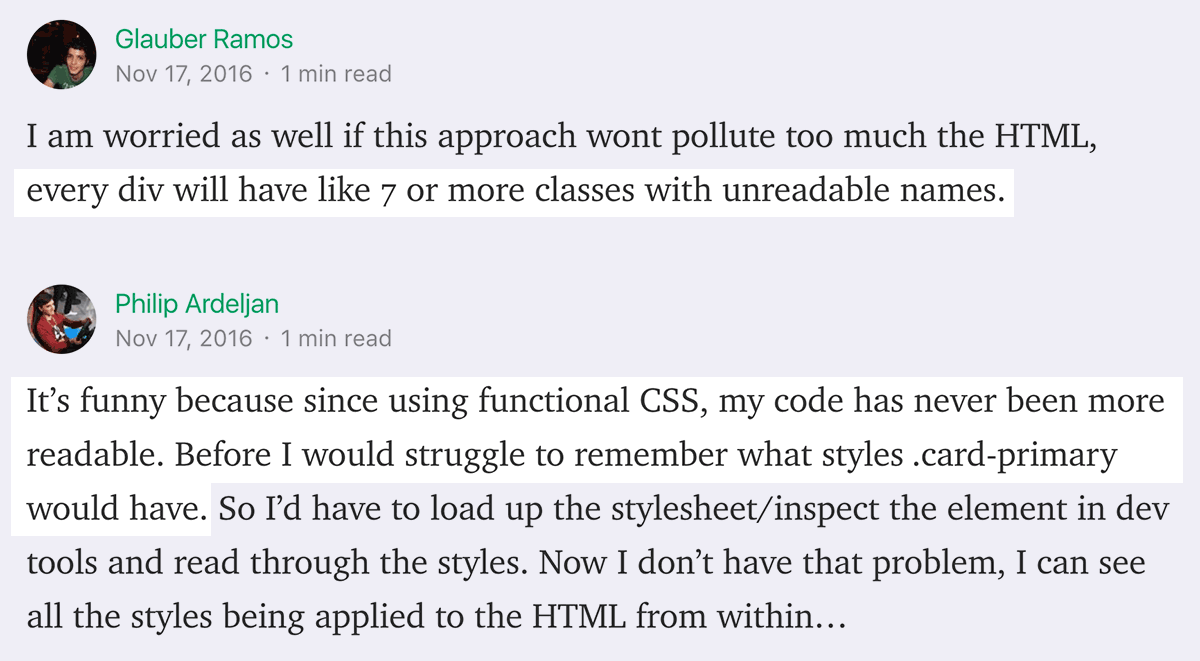
HTML Bloat?

“If we put Gzip into the picture, things look even better. That’s because a lot of repetitions means a better compression ratio.”
Atomic CSS FAQ
“HTML is much less difficult to reason about than layers of CSS inheritance.”
Sean Washington
CSS is hard — Thoughts on managing the cascade
A Trade-Off
Less classes in stylesheets.
More classes in HTML.
How is this different
from inline styles?
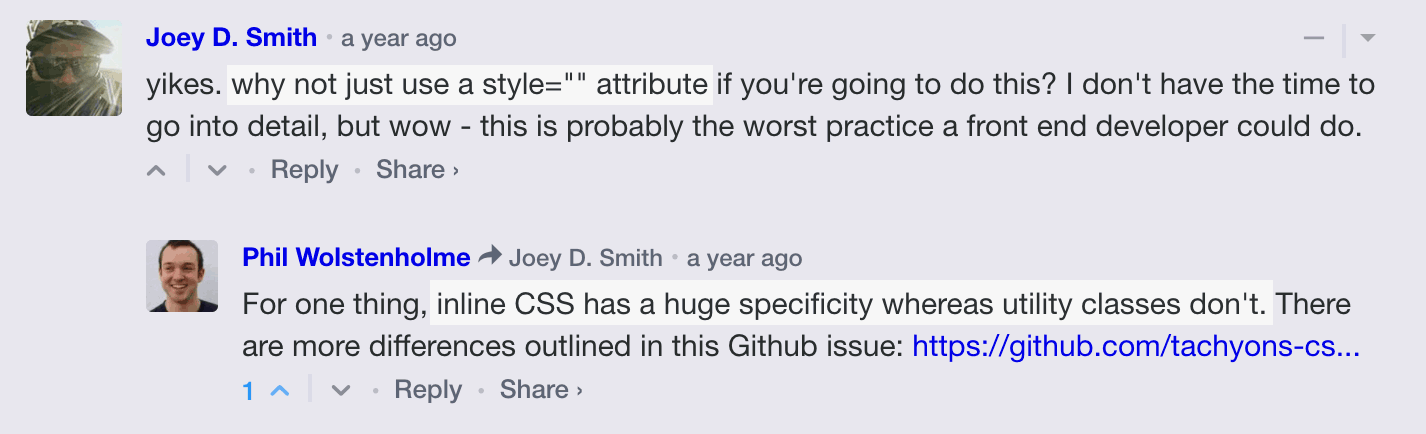
Excerpts from
How is tachyons different from inline styles?
“The most important difference is specificity.
Mark Otto
Inline styles trump classes.”
Creator of Bootstrap
“Inline styles do not support media queries or pseudo elements.”
“Inline styles are 1 to 1 for the browser.
While a class has a 1 to many relationship.”“In the world of inline styles,
Adam Morse
I have to memorize padding and margin values.
A codified system can have named sizes like S, M, L.
Creator of Tachyons CSS
Excerpts from
Cooking with Design Systems
“If you’re using class names instead of inline styles, you won’t ever have a situation where one headline has 16px padding and another has 17px. You’re using your design system!”
“Using your already established conventions through class names gives you a beneficial constraint.”
Dan Mall
Founder and Director of SuperFriendly
Creative Director at Studio Zeldman
What about a redesign?

“The theory that an entire site can or should be redesigned by just changing the CSS isn’t practical and doesn’t reflect how real designers and developers approach new projects.”
Philip Walton
“Defending Presentational Class Names”
( e.g., There are 4 versions of Bootstrap )
Bye Bye Cascade

Another trade off.
More cascade means more complexity.
Atomic CSS favors simplicity.
How about Accessibility?
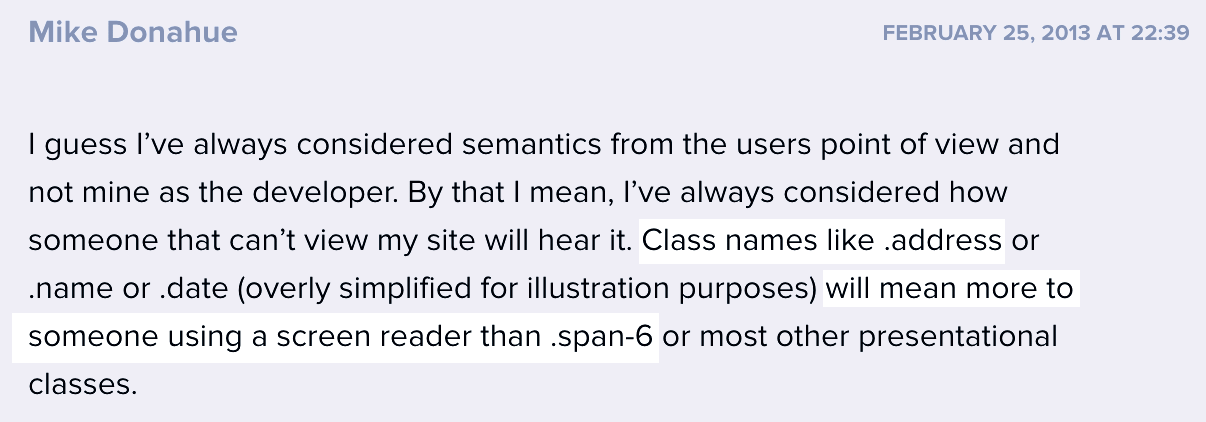
Assistive devices ignore class names.
Browsers do not care what your classes are named.
Users do not care what your classes are named.
The only people who do care are...
other developers!
What about Semantics?

“SORRY. I disagree.
Jeffrey Zeldman
Nonsemantic classnames that refer to
visual styles will always be a bad idea.”
Web Pioneer
Kiss My Classname
“For individuals weaned on an ideology where ‘Semantic HTML’ means using content-derived class names, it usually requires you to work on a large application before you become aware of the impractical nature of that approach.”
“You have to be prepared to disgard old ideas, look at alternatives, and even revisit ways that you may have previously dismissed.”
Nicolas Gallagher
About HTML semantics and front-end architecture
March 15, 2012
“If you use templates, then giving a meaningful name to the file should be enough. In my opinion, limiting yourself to style things through semantic class names is counter-productive.”
Thierry Koblentz
Challenging CSS Best Practices
October 21, 2013
“We have tags and attributes (ARIA, etc.) to describe content.”
“Our philosophy is that visual styling should be decoupled from content.”
John Polacek
Kiss My Classname: A Counterpoint
Some People Really Really Just Do Not Like It

(Fun Fact: Medium is built with Atomic CSS)
Maybe try for yourself, then decide
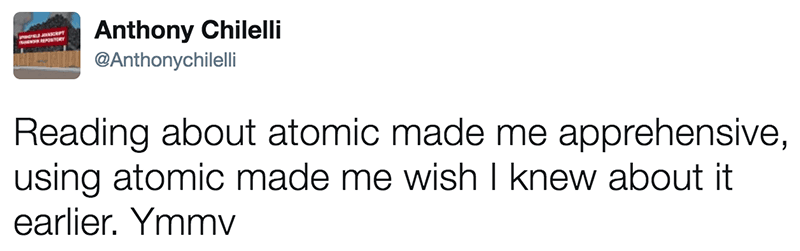
Bonus points for writing about your experience!
Where is Atomic CSS
Used in the Real World?
ACSS.io View Project
Atomic CSS on Steroids
Developed at Yahoo
Configure with Atomizer
Tachyons View Project
Very Popular
Extensive Components Library
Configure with PostCSS
Basscss View Project
Influential, Widely Used
Configure with PostCSS
Solid View Project
From the Team
at Buzzfeed
Configure with SASS
Shed View Project
From the Team
at TED
Configure with PostCSS
Expressive CSS View Project
From the Team
at Gesture
Configure with SASS
Marvel App View Project
Styleguide for Marvel App’s CSS
Bootstrap v4 View Project
Extensive use of
Atomic-style
utility classes
How do I get started with Atomic CSS?
Starting a New Project
Pick a Framework
or...
Roll Your Own
(It’s not that hard)
Take a Framework Tour
Go Static
Tachyons Basscss SolidGet familiar with them, then make your own by adjusting the SASS, PostCSS, etc.
Go Programmatic
ACSSDon’t like shorthand?
Configure as you see fit.
Other Functional Flavors
For React
Getting Started with Tachyons and React
React Functional CSS Protips
CSS in JS
CXS
Styletron
Polished
Rolling Your Own
Configuration
- Grid / Spacing / Layout
- Typography
- Colors
- Utilities
- Responsive Overrides
Managing Complexity
Template Organization is Key
Create Components with Partials/Fragments
Building a Library is Helpful
What about .btn?
“We should favor both approaches to achieve our goals. A ‘semantic’ name makes sense as a needed hook, not as a general rule.”
Thierry Koblentz
Challenging CSS Best Practices
October 21, 2013
<button class="btn bgr-red">What about .card?
How about a template partial named card instead?
( Do what works for you )
What about Refactoring?
Analyze First
CSS Stats View Project
Get statistics on your CSS
Atomize IO View Project
See how much your site can benefit from Atomic CSS
CSS Purge View Project
Learn and compare your amongst 42 popular sites and frameworks
Decision Time
Go Gradual
or...
Bandaid Rip
Taking It Slow
Step 1
Find the most common style declarations in your CSS.
Step 2
Pick a theme
(e.g. typography, colors, spacing)
Replace with Atomic classes.
Go for big wins first.
Step 3
Repeat Step 2 until satisfied.
Rip That Bandaid
Step 1
Add Tachyons*
to the end of your CSS.
*or another Atomic library
Step 2
Do a first pass.
Methodically remove legacy classes, replace with Atomic classes.
Step 3
Kill all legacy CSS. Assess the damage.
Refactor to Tachyons, extend as needed.
Use other tools or restore legacy CSS only when necessary
Source
Full re-write in 10 days with Tachyons and Functional CSS: A case study
Read the full case study
The switch to Tachyons resulted in a 50% file size reduction and 75% fewer style declarations.
Exciting Times for the Front End
Always new things to try
Write about what you learn
Open Source your work
Questions?
Find me on Twitter @johnpolacek
Slides are at johnpolacek.com/rethinking
One more thing...
Built with
TweenDeck
Next level animation for web presentations
Go to TweenDeck on Github
